


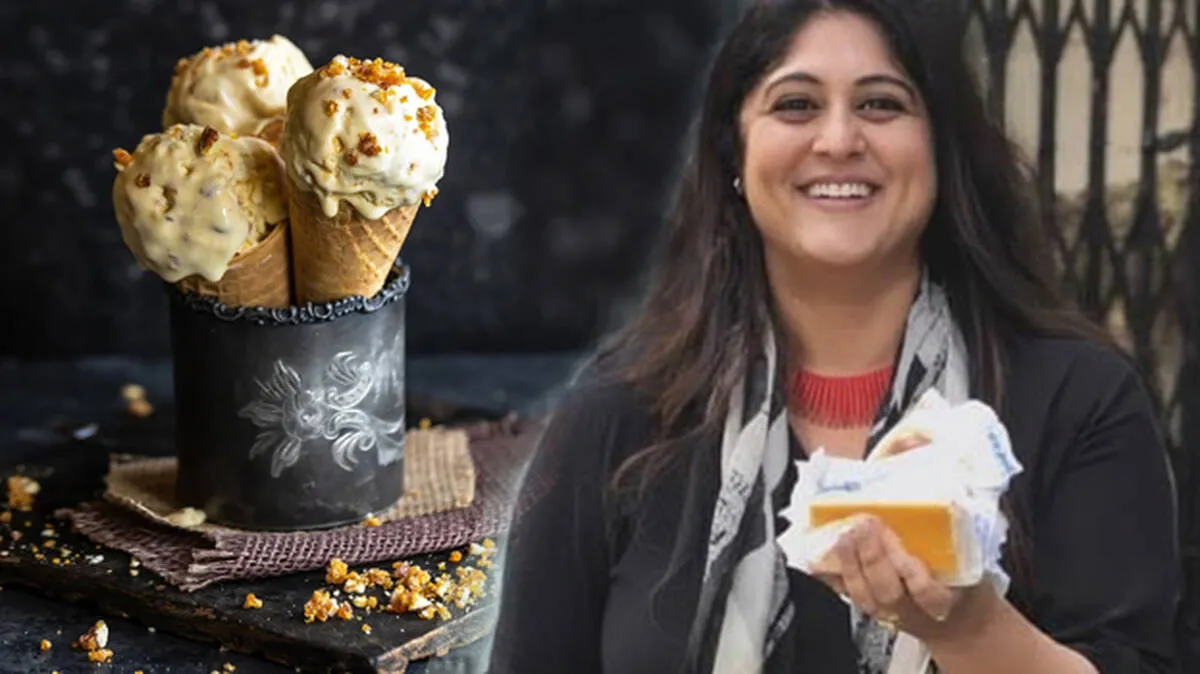
Butterscotch is a familiar presence in ice creams, cakes, puddings and other desserts. But what does the name ‘butterscotch’ actually mean? And does the flavour really have anything to do with butter and Scotch?
That was the curious question raised on social media by Tara Deshpande Tennebaum, a former actor who went on to establish herself as a trained chef and food writer. She has studied at the French Culinary Institute in New York and Le Cordon Bleu in Paris and London, and is the author of cookbooks including A Sense for Spice: Recipes and Stories from a Konkan Kitchen and An Indian Sense of Salad. Her post, however, began with a joke. Butterscotch ice cream, she suggested, had been “cheating” people for years despite containing neither butter nor Scotch.
“Shocking! Butter Scotch ice cream has been cheating the public for years. It has neither butter nor Scotch in it!! Can someone let Tukaram Mundhe know,” she wrote on X, referring humorously to food safety official Tukaram Mundhe. The joke sparked curiosity about the real story behind the flavour, prompting Deshpande to follow it up with a detailed account of butterscotch’s history.
The first misconception to clear up is the obvious one: butterscotch is not a combination of butter and Scotch whisky. Traditional butterscotch was a confection made with butter and sugar, with historical recipes also using treacle, a thick syrup produced during sugar refining. An 1848 recipe for “Doncaster butterscotch”, for instance, called for butter, sugar and treacle. So, the original confection really did contain butter. The Scotch connection, however, is much less certain.
The exact origin of the word “scotch” remains disputed. One widely cited theory links it to the process of “scotching” or cutting the cooked confection into pieces before it hardened completely. Other theories have connected the word to Scotland or to “scorch”, but none has been conclusively established.
Butterscotch has a particularly strong historical association with Doncaster in Yorkshire, England. According to Deshpande’s account, its story goes back to 1817, when Samuel Parkinson began making a confection known as “Butter Drops” in Doncaster. The Parkinson business later became closely associated with butterscotch and helped make the sweet one of the town’s best-known products.
The precise claim that Parkinson invented butterscotch in 1817, however, is harder to establish as fact. What is clear is that early references strongly associate the confection with Doncaster. A recipe for “Doncaster butterscotch” appeared in the Liverpool Mercury in 1848, while the term had also appeared in Lady’s Newspaper the previous year. The 1848 recipe used butter, sugar and treacle, ingredients consistent with the traditional confection.
The butterscotch most Indians grew up eating is somewhat removed from the original confection. In India, the name is now strongly associated with butterscotch ice cream, particularly the crunchy praline or nutty pieces commonly associated with the flavour.
Deshpande traces this distinctly Indian version to Kwality’s butterscotch ice cream, which she says was launched in 1958 with praline added to the flavour. According to her account, that addition helped establish the association between butterscotch and crunchy caramelised nuts in India. Over time, the flavour moved well beyond ice cream, finding its way into puddings, cakes, sauces, sundaes and other desserts.
So, the next time you order a butterscotch ice cream, there is indeed a connection to butter — but not to Scotch whisky. And that mysterious “scotch”? Its exact story remains a matter of debate.













 HOME
HOME LATEST
 NOTIFIED NEWS
 POLL
POLL KERALA
  EDITORIAL
  INDIA
INDIA  WORLD
WORLD  CINEMA
  SPORTS
  LIFESTYLE
  SPECIAL
  SCIENCE & TECHNOLOGY
 |
|